



Published on April 14, 2026 · Updated on October 2, 2026
The problem isn't AI, it's the scope.
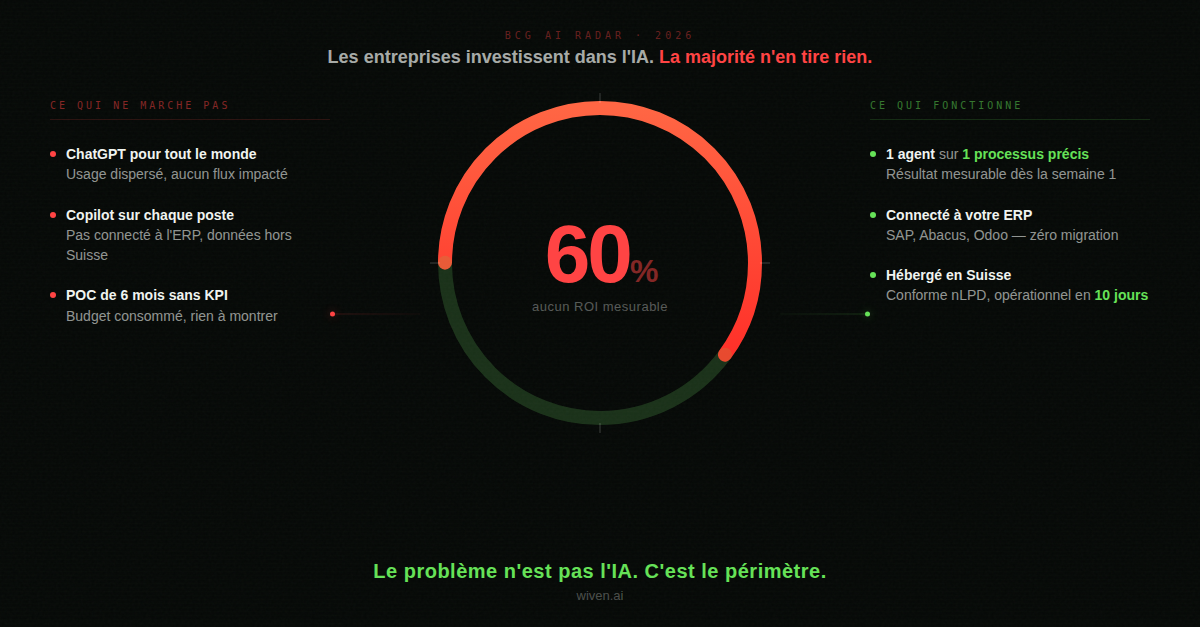
According to a BCG study published in September 2025, 60% of companies were deriving virtually no tangible value from their AI investments. A year later, the same firm estimated that nearly half were now generating value: the gap is widening between those who are properly framing their projects and those who aren't. This figure doesn't mean that AI doesn't work. It means that most organizations are deploying it in the wrong place, on the wrong scale, with the wrong unit of measurement.
The problem is almost never technological. It is methodological. And it hinges entirely on one concept: scope.
1. Why do 60% of companies gain nothing from it?
When we look at AI programs that fail, we almost always find the same patterns. These aren't problems with artificial intelligence. They're problems with the framework.
ChatGPT for everyone. The company signs a collective license, sends an onboarding email, and considers the topic addressed. Six months later, usage is scattered, everyone is using it in their own way, and no business processes have been transformed. We're measuring prompts, not value.
Copilot on each station. Mass deployment, without connection to the ERP or business data. Employees write emails faster, but decision-making processes remain unchanged. And often, the data ends up being hosted outside of Switzerland—which poses a completely different problem.
The six-month POC without KPIs. Budget spent, presentations successful, but nothing to put into production. Because nobody had defined, from the outset, what "it works" meant.
2. The perimeter is the real issue
The scope is the precise area within which AI is expected to produce a result. Not "improve productivity." Not "transform customer relationships." A specific process, a specific team, a specific metric.
This is what successful 40%s do differently. They don't try to "do AI"—they try to solve a specific problem. The difference may seem cosmetic, but it's fundamental.
«"We want to deploy AI within the company to improve efficiency."»
«"We want to reduce the processing time for incoming supplier invoices in our Abacus ERP system by 70%, for the accounting team."»
The first project will never finish. The second can produce a measurable result in two weeks.
3. What works — three non-negotiable conditions
AI projects that produce a ROI share three characteristics. These are not incidental. They are the condition for everything else to exist.
One agent, one process. Not a universal platform. An agent dedicated to a specific task — invoice reconciliation, lead qualification, level 1 ticket response — with measurable results from the first week of production.
Connected to your ERP. SAP, Abacus, Odoo, or your actual business stack. Zero migration, zero "data lake" to build before starting. The agent works on your data, where it is.
Hosted in Switzerland. Compliant with nLPD, excluding extraterritorial jurisdictions. Not an optional compliance measure — a prerequisite if you process Swiss customer data.
4. Refocusing a stagnant AI project
If you've already launched an AI initiative and are struggling to demonstrate results, the answer is probably not to add another layer of technology. It's to narrow down the scope until it becomes measurable.
Take the project that's stalling. Ask yourself: which team is the only one that will change the way they work? Which workflow is the only one that will be automated? Which number is the only one that needs to change? If you can't answer these three questions in one sentence each, you don't have an AI project—you have an AI ambition.
And AI ambitions don't produce ROI. Net scope does.
Can your current AI initiative produce a measurable result within the next ten days? If the answer is no, it's not a technology problem. It's a scope problem.
AI works. It works very well, in fact—for the 40%s who have deployed it within the right scope. The question isn't whether AI is mature. It is. The question is whether you apply it to a problem specific enough for the result to be noticeable.
Sources
- Are You Generating Value from AI? The Widening Gap, BCG, September 30, 2025.
- AI Is Starting to Pay Off. Almost 50% of Companies Now Generate Value with It, BCG, September 30, 2026.
Do you have an AI project that isn't taking off, or do you want to define the scope before launching?