



Published on March 4, 2026 · Updated on October 2, 2026
Your company uses AI. But has it truly integrated it?
Artificial intelligence has spread throughout businesses through its use. Teams experiment, managers automate certain tasks, and business units improve their analyses. The benefits are immediate.
However, in many organizations, these initiatives do not actually transform operational functioning. Processes remain unchanged, and execution still largely relies on human judgment.
This discrepancy is not technological. It is architectural.
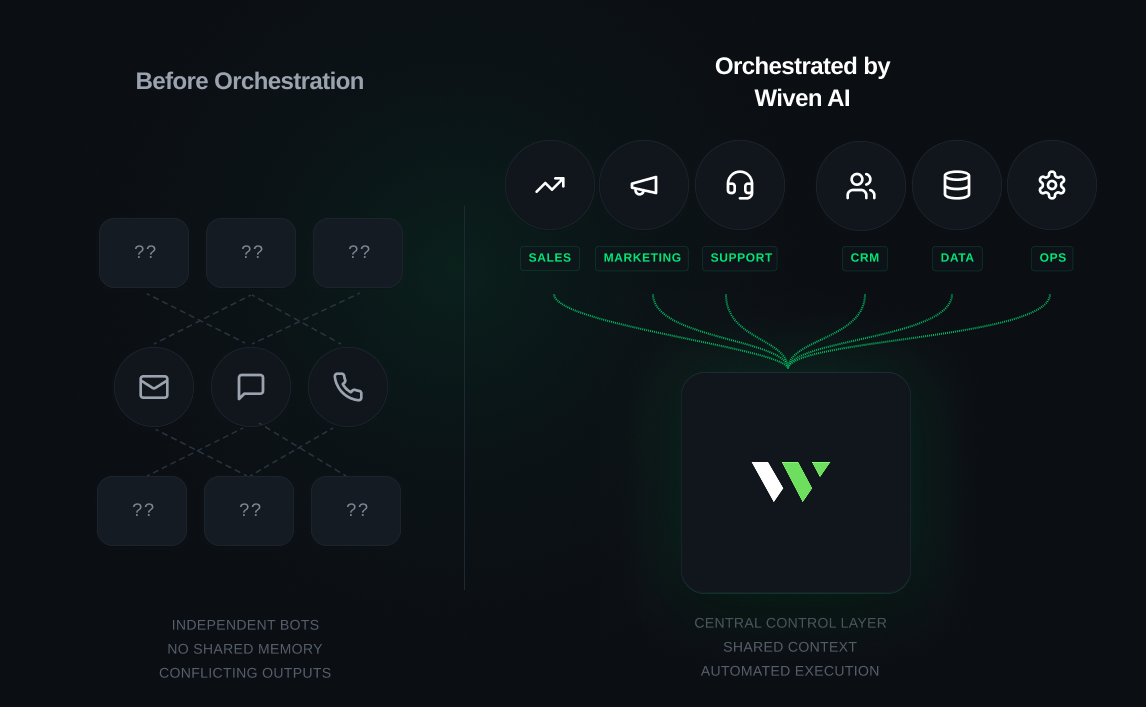
The risks of a dispersed adoption
When adopted in a decentralized manner, these technologies gradually introduce several risks.
Fragmentation
Each team develops its own practices and automates certain processes according to local rules. In the short term, responsiveness improves. In the medium term, overall consistency weakens.
The loss of traceability
In environments subject to compliance requirements, uses not integrated with central systems complicate governance and make processes more difficult to audit.
Technical and organizational debt
The accumulation of isolated initiatives introduces implicit dependencies and heterogeneous logics. As long as uses remain limited, this debt is barely visible. It becomes problematic when the company seeks to industrialize or scale up.
As in software engineering, decisions that are relevant in the short term can generate significant alignment costs in the long term.
From assistance to integrated execution
The answer lies neither in multiplying pilot projects nor in launching large-scale transformation projects. It requires a change of mindset: integrating these capabilities into the heart of the processes.
It is no longer just about assisting a colleague, but about participating in the execution of flows within a governed framework.
Many tickets concern recurring requests governed by explicit rules. When an agent is integrated into the information system, these flows can be processed automatically, with internal rules applied and logging in central systems. Complex cases remain monitored, but routine processing is standardized and traceable.
Onboarding a new employee involves multiple departments and often requires manual coordination. Structured orchestration allows the necessary steps to be automatically sequenced while ensuring process visibility.
In both situations, the transformation relies less on the technology than on its coherent integration into the existing architecture.
An architectural challenge
Access to tools is no longer a differentiating factor. What distinguishes organizations is their ability to structure their integration.
The question becomes architectural: how to organize an execution layer on top of existing systems without adding unnecessary complexity?
Some companies are undertaking complex technical projects. Others are allowing scattered uses to proliferate. One alternative is to gradually structure specialized agents, integrated into existing ERP and business tools, with clearly defined scopes and explicit governance.
The Wiven approach
Wiven's approach is based on this logic. AI Workers are designed as business agents positioned above existing systems. Their role is not to replace the existing architecture, but to structure its execution.
Defined perimeters. Each agent is guided by explicit rules and progressively integrated into operational flows, limiting the accumulation of technical and organizational debt.
Gradual deployment. Activating agents on high-value processes without a complete overhaul of the infrastructure.
Local compliance. Proximity in a Swiss and European environment facilitates alignment with compliance and data sovereignty requirements.
Improving individual practices is a useful step. However, it is not enough to bring about lasting transformation in an organization. The difference lies in the ability to structure execution and integrate these new capabilities into a coherent and governed architecture.
Is your information system designed to absorb these changes without creating further fragmentation?
Contact us for a personalized 20-minute audit