



Published on March 9, 2026 · Updated on October 2, 2026
Your AI agent may be down right now. And you don't know it.
He continues to accept requests. It no longer responds correctly. It blocks flows silently. Your teams are waiting. No one knows why.
This is not a disaster scenario. This is the common reality of organizations that deploy AI agents without a supervisory architecture.
The silent fault has no alarm signal. She has an employee who is surprised that her request has not been processed for three days.
1. Why an AI fault is different from a classic fault
When a server falls, an alert is triggered. When an app crashes, users see an error message. When an AI agent fails, nothing happens — or almost nothing.
It may continue to respond incorrectly, transmit erroneous data, not trigger the expected actions. A classic failure is binary: it works or it doesn't work. An AI outage can be partial, silent, gradual — and it produces errors for as long as it goes unnoticed.
A classic fault stops. An AI failure can continue to produce invisible errors until someone comes back up the wire — often too late.
2. The three forms of breakdown that no one anticipates
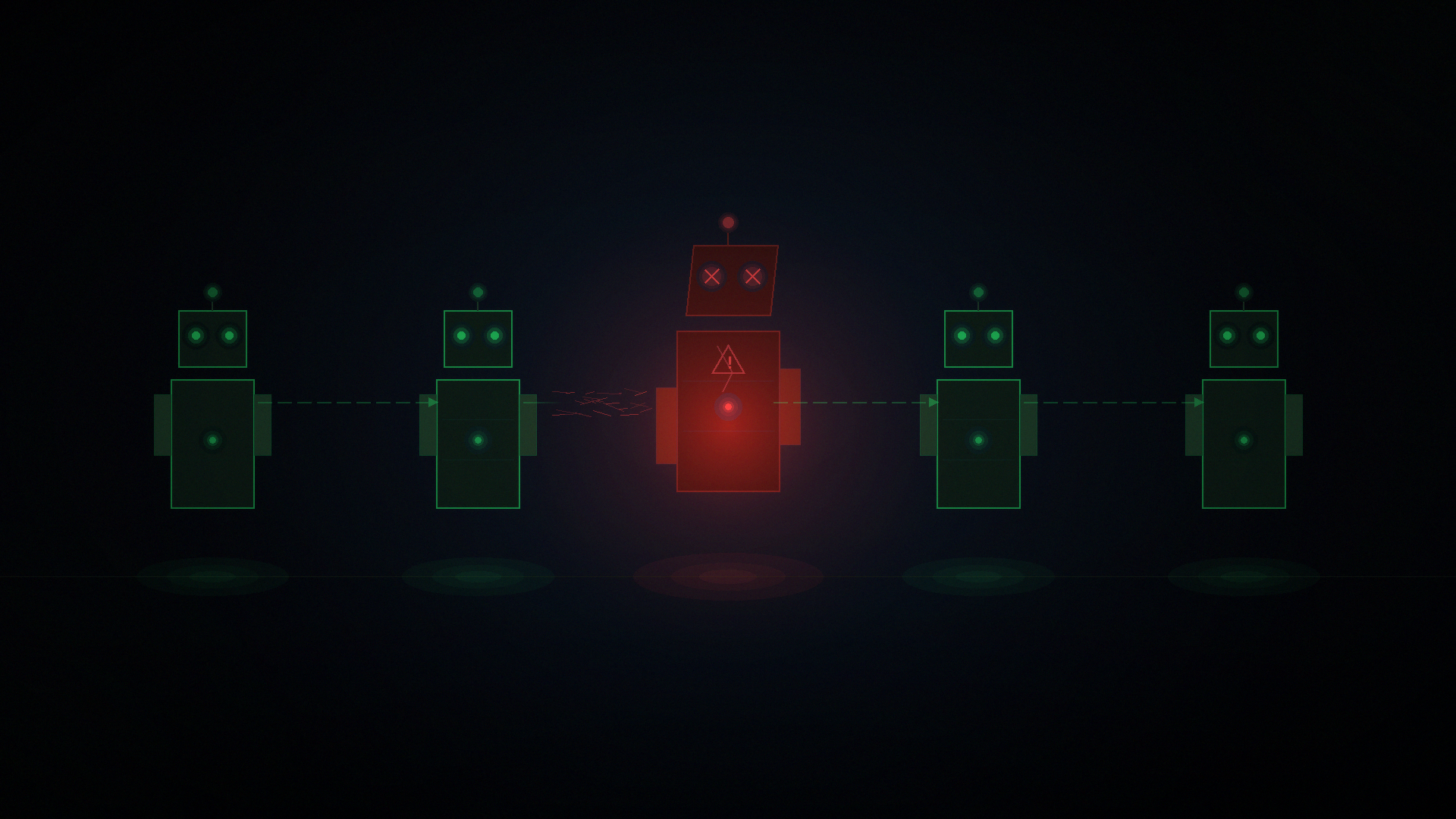
The blunt failure — the agent stops completely — is the least dangerous because it is visible. The other two are much more insidious.
The silent breakdown
Agent works, but produces incorrect results. An expense control officer at a Swiss SME continues to validate expenses, but his classification model has deteriorated. Non-political expenses go without warning. The financial department only discovers this at quarterly closing.
The cascading failure
A failed HR agent no longer transmits onboarding data to the IT agent responsible for creating access. The new employee arrives on Monday morning without access to their tools. Without an isolation mechanism, a link breaks the entire chain — silently.
3. How it really goes when it breaks
The fault was not detected by a system. She was detected by an employee who was surprised that her leave request had not been processed for three days. She talked to her manager about it. The manager spoke to the HRD about this. The HRD called the CIO. The CIO has opened a ticket.
This is how AI monitoring works in the majority of organizations today: by human feedback, after the fact.
In the meantime, the agent kept spinning. Other requests remained blocked. Other data has been mishandled. When the CIO finally opens the logs — if they exist — he must reconstruct the history manually, agent by agent, without a transversal view. What should have taken twenty minutes takes three hours.
For the CFO, it is a reconciliation to be redone by hand. For the HRD, this is a loss of confidence in the tools — difficult to rebuild in a context where the teams' commitment to change is never acquired. For the CEO, this is an uncomfortable question: if it happened once, how many times did it go unnoticed before?
And for auditors — in an LPD or GDPR environment — the question is even more direct: who was responsible for this automated decision? Which agent took it? On what basis? Without traceability, there is no answer.
If one of your AI agents goes down tonight, how long before someone detects it? How long does it take to understand the impact? How long to resume?
4. The real problem: an architecture that did not predict failure
Silo deployment makes sense the moment it happens. Each team has its perimeter, its budget, its agent. It works as long as everything is fine.
But when it breaks, this organization becomes a trap. No one has the big picture. No one has access to intervene on the agents of the other teams. And no one knows exactly what is impacted — until the consequences come up by the employees themselves.
This is not a technological problem. It's a design issue. An architecture that is deployed without predicting failure is an architecture that turns incidents into crises.
5. What orchestration changes with Wiven
Wiven does not make AI agents foolproof. What it brings is the ability to see, isolate and recover — before a technical incident becomes a business incident.
Wiven is designed for the realities of Swiss and European companies: LPD and GDPR requirements, need for traceability for auditors, integration into environments where data governance is non-negotiable. It's not an extra layer — it's an architecture designed for your context.
Concretely: each agent operates in a supervised flow. If one agent fails, the flow interrupts in a controlled way — the other agents do not receive corrupted data. An alert immediately goes up with the full context: which agent, which flow, which action, at what time. The CIO knows where to look. Business teams know what is impacted and what continues to work.
In the initial scenario: the employee would not have had to wait three days. The problem would have been detected, located and assigned before she noticed.
| Dimension | Without governance | With Wiven | Concrete benefit |
|---|---|---|---|
| Awareness | Manual reporting — if anyone notices | Centralized monitoring, immediate alert | The incident is known before it goes up |
| Diagnostics | Partitioned investigation, no shared logs | Logs traceable by agent, by flow, by action | Source is quickly identified |
| Impact perimeter | Unknown until climbing | Impacted flows visible in real time | Informed decision, no over-reaction |
| Reprise | Manual restart, risk of cascading errors | Controlled recovery, flow by flow | Preserved business continuity |
| Traceability | Absent or fragmented | Each documented, assignable, auditable action | LPD/GDPR compliance ensured |
WHAT YOU SHOULD REMEMBER
The AI maturity of an organization is not measured by the number of agents deployed. It is measured by its ability to detect, isolate and recover in the event of failure — in a traceable and compliant manner.
For Swiss and European companies, this requirement is not optional. The LPD and GDPR impose accountability on automated decisions. An architecture without governance is not just an operational risk — it is a compliance risk.
- Do you know in real time if all your agents are working properly?
- Can you identify the impact of a breakdown before it is escalated by an employee?
- Are your AI logs auditable and compliant with your regulatory obligations?
If you answered no to any of these questions, your architecture is exposed — operationally and regulatoryly.
Wiven offers a 3-step diagnosis:
The deployment is gradual — a flow, a defined perimeter — with operational visibility from the first weeks.