



Published on April 7, 2026 · Updated on October 2, 2026
Swiss SMEs and AI: why adoption isn't enough — and how to really benefit from it
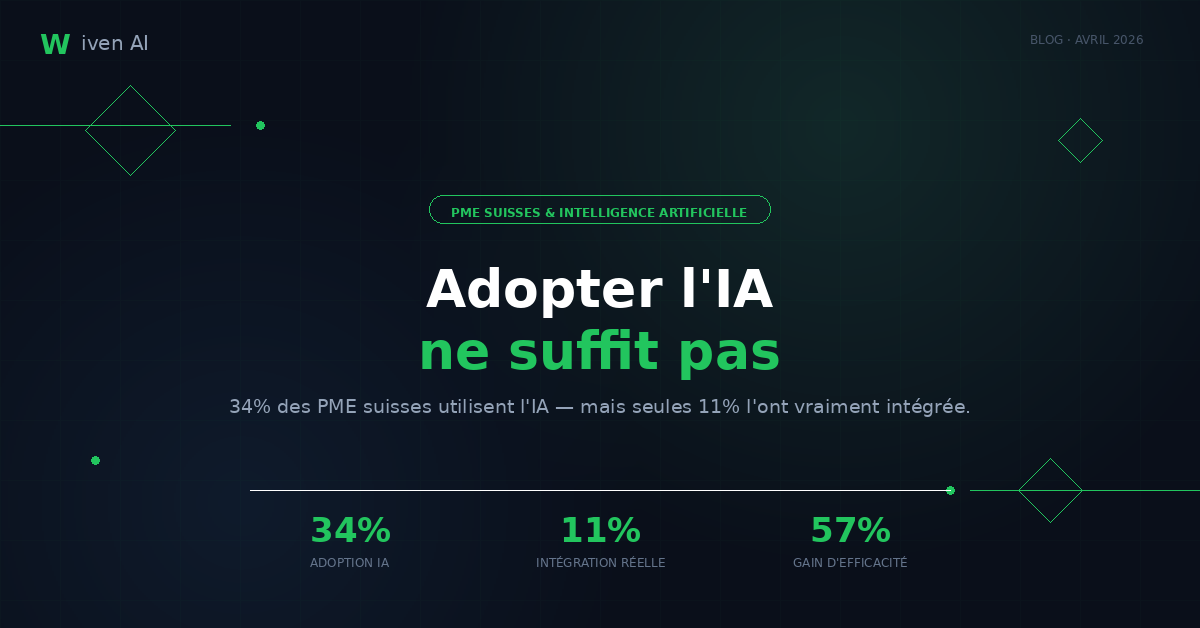
In one year, the proportion of Swiss SMEs integrating AI into their work processes rose from 22% to 34%, according to AXA's SME 2025 study conducted by the Sotomo Institute. The figure looks impressive in a report. But on the ground, the reality is less rosy: the most frequently cited uses remain peripheral, and only one in three SMEs using AI has established clear data protection rules.
The problem is not adoption. It's what we do — or rather what we don't do — after adopting.
1. The trap of "using AI" without a strategy
The most frequently cited uses by SMEs are translation (52 %) and correspondence (47 %). These are peripheral uses — useful, but which do not affect processes, decision-making, or the value chain.
It's a bit like buying a CNC machine and only using it to drill holes. The machine works, but you're only using a fraction of its potential.
What separates SMEs that have truly integrated AI from the others is not budget or size. It's a question of method: they have identified a precise, measurable, repetitive process — and they have applied AI to it in a targeted way.
2. Why the blockage is not technical
It's often said that SMEs lack the resources or skills to deploy AI. This is becoming less and less true. The tools exist, costs have fallen, and cloud solutions make the infrastructure accessible to any company of ten people.
The real obstacle is organizational. Three obstacles consistently recur in the companies we support in French-speaking Switzerland.
The lack of AI governance. No one is in charge of the subject. AI arrives through the back door — one employee tests a tool, another uses a chatbot — but no overall vision guides the choices.
The lack of acculturation. Uses arise from individual initiatives, rarely accompanied by training or rules of use. Without training, even the best tool remains underutilized—or worse, misused.
The question of data. AI needs structured and accessible data. However, many SMEs still operate with silos—ERP on one side, Excel files on the other, emails in the middle. As long as the data doesn't flow, AI is useless.
3. The method that works: a process, an agent, a result
Companies that successfully integrate AI don't launch large transformation programs. They start small — but they start well.
The approach consists of three steps. First, identify a painful process: repetitive, time-consuming, and prone to errors. Invoice processing, lead qualification, document compliance checks—these are the kinds of tasks everyone hates but no one has time to rethink.
Next, deploy a specialized AI agent for this specific scope. Not a generic tool. An agent that understands the business context, integrates with the existing ERP, and produces verifiable results.
Finally, measure it. Not in six months—start in the first week. According to the AXA study, 57% of SMEs using AI report saving time, compared to 46% a year earlier. For this time saved to become a tangible result, it must impact a specific process: the difference lies in the precision of the scope.
4. What this means for your SME — in concrete terms
If you run an SME in Switzerland and are already using AI for isolated tasks, you're about average. This isn't a criticism—it's a starting point.
Taking things to the next level doesn't require a multinational budget. It requires a decision: choose a process, assign an AI agent to it, and measure the results. Most SMEs that make this choice see a measurable impact within weeks—not quarters.
Data sovereignty is also a decisive factor. Foreign cloud solutions raise legitimate compliance questions, especially with regard to the Swiss Federal Act on Data Protection (FADP). Favoring local partners who understand the Swiss regulatory framework is not protectionism—it's prudence.
Not "do we use AI?" but "does the AI we use affect a single critical process in our business?" If the answer is no, you haven't started yet.
AI in Swiss SMEs is no longer a question of "if" but of "how." The figures show that adoption is progressing. What's lacking is depth. And depth can't be bought—it's built, process by process, with the right method and the right partner.
To go further: how to deploy a Swiss AI agent tailored to your SME.
Sources
- SME Study 2025: Artificial Intelligence (Sotomo Institute, 300 SMEs), AXA, October 8, 2025.
Your SME uses AI — but has it really integrated it?