



Published on March 16, 2026 · Updated on October 2, 2026
How an AI agent reduces errors and time lost on invoices
The processing of invoices by an AI agent is still rare in Swiss SMEs — and yet many have already tried to automate their finance. Most failed — not because the technology didn't work, but because they solved the wrong problem.
It's that starting point that changes everything.

1. Why Automation Attempts Didn't Keep Their Promises
The sequence is always the same. A management decides to invest in a tool — EDM software, OCR module, validation workflow. Teams are trained. The project is launched. Six months later, the process has changed in form, but not in nature. The manual work is still there, moved from one stage to the next.
The reason is structural. These tools have automated document capture — not the decision chain that follows. Is the supplier referenced? Does the amount match the purchase order? Are the contractual conditions respected? These checks — repetitive, systematic, settled — remained human. And that's precisely where the mistakes creep in.
2. What manual invoice processing really costs
The visible cost is known: time, resources, an operational load that increases with volume. But that's not where the real impact is.
The invisible cost is elsewhere. An employee who processes fifty documents a day under pressure of deadlines cannot maintain the same level of attention on each line. It's not a matter of skill — it's a mechanical consequence of volume and repetition. A badly read reference, an inverted amount, an undetected duplicate: the problem is not seen at the time it occurs. It is seen at the end of the month, during a supplier dispute, or during an audit.
Not “how much time does my team spend on invoices?” but “how many avoidable errors does this process generate — and what is the total cost, including reconciliation, litigation, and regulatory exposure?”
3. What an AI agent actually does on your invoices
An AI agent built into the invoice processing flow does not replace human judgment. It supports what should never require it — consistency checks, compliance checks, systematic reconciliations.
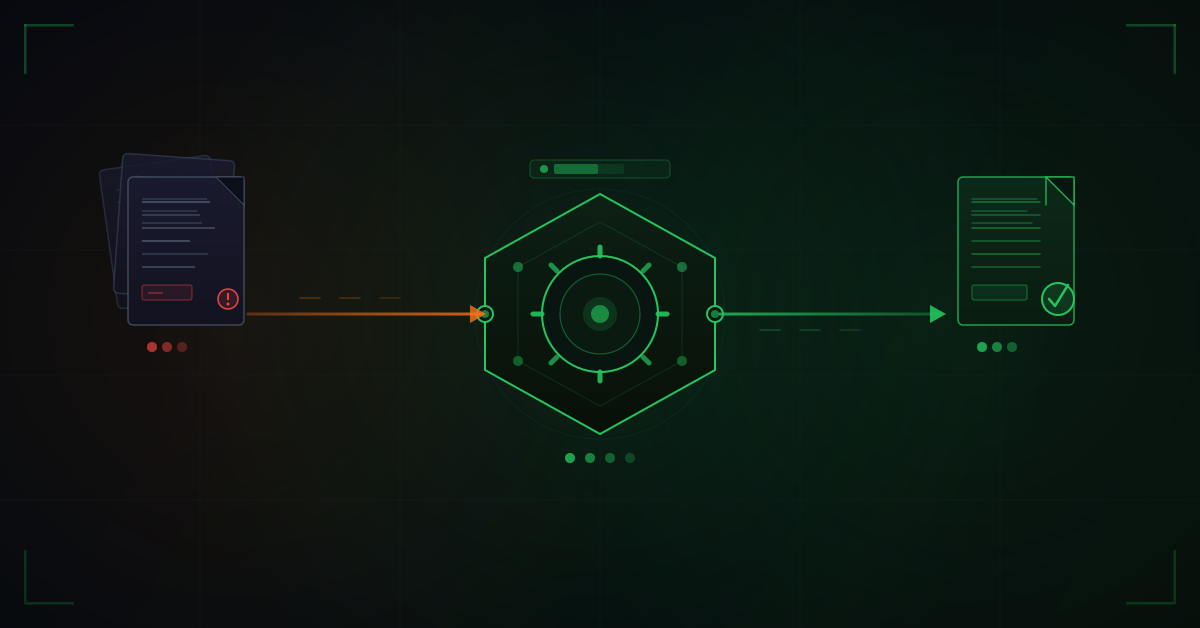
As soon as a document arrives, the agent analyzes it, extracts key information and compares it with data from the internal system. If everything is consistent, he prepares the entry into accounting. If an anomaly is detected, it immediately reports it with the necessary context for an employee to make a decision in a few seconds.
Volume-independent reliability. The quality of the process no longer depends on the load level or turnover of the teams.
Scalability without additional staff. Volume growth no longer requires a proportional increase in human resources.
Full traceability and LPD compliance. Each action is tracked, auditable, compliant with regulatory requirements that are becoming more stringent.
4. What it reveals about your organization's AI maturity
This case goes beyond finance. If your invoice processing process is still largely manual in 2026, it's rarely a budget or priority issue. This is a signal on how your organization is approaching AI integration.
Successful companies share one thing in common: they have not sought to replace their systems. They have integrated specialized agents above the existing one — ERP, business tools, validation flow — with defined perimeters, explicit rules, clear governance.
A process, a perimeter, an agent. No overall redesign. No promise of transformation in twelve months. It is this logic of progressive integration that distinguishes organizations that move forward from those that accumulate pilot projects without a future.
Not “do we have AI?” but “is our AI embedded in execution — or only in presentations?”
Invoice processing is not a glamorous topic. That's exactly why it's a good developer. Organizations that have solved it well have generally solved the rest well.
Frequently asked questions
How to avoid billing errors using AI?
An AI agent reads each invoice, extracts the amounts, VAT, and references, then automatically matches them to orders and accounting entries. Inconsistencies (duplicates, incorrect amounts, incorrect VAT) are flagged before validation, significantly reducing manual data entry errors and subsequent corrections.
What accounting software can an AI agent connect to?
The agent connects to your existing tools without replacing them. It integrates with, among others, Abacus and to bexio to synchronize invoices, entries and reconciliations directly in your accounting.
How much time does an AI agent save on invoice processing?
By automating reading, sorting, and matching, an AI agent processes in seconds what takes several minutes per invoice through manual processing. Your teams can then focus on complex cases and quality control rather than data re-entry.
Is your financial process automated — or just digitized?